

Shove It.
To Washington, to the naysayers, and to every pundit who said Canadians wouldn't follow through — the numbers are in. Canada wins.

Hello everyone,
Pierre Poilievre stood before the Canadian Club in Toronto last month and delivered his verdict on Mark Carney and his government.
“The gap between Mr. Carney’s boasting and his results is perhaps unprecedented,” he declared. On a podcast shortly before, he had gone further still: “There’s one thing that’s worse than being uneducated and it’s being badly educated. And Mr. Carney is very badly educated on economics.”
The Conservative social media machine amplified it with relish. It has been something to behold — not measured political criticism but something nastier, more personal, more contemptuous. Online pile-ons that stopped being commentary long ago and became a coordinated effort to humiliate. Journalists and pundits joined the chorus. Analysts questioned whether the Prime Minister’s Major Projects Office was anything more than a rebranding exercise. The Globe and Mail’s business section asked pointedly whether Carney’s infrastructure push was merely “a patchwork” leaving “holes in economic growth.” The Fraser Institute dismissed the early MPO announcements as “decidedly underwhelming.” Al Jazeera, a Middle Eastern TV network, in a lengthy assessment of Carney’s first year, concluded that his biggest challenge in 2026 would be “implementation and delivery” — the implication being that delivery had been conspicuously absent.
Where’s the beef, they all asked. Where are the results?
This week, reality offered two answers. Neither the critics, nor the pundits, nor the online army saw either one coming.
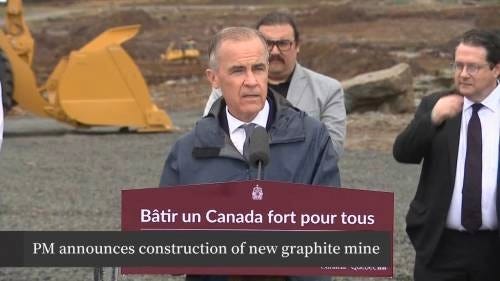
Today — May 19, 2026 — Prime Minister Mark Carney personally broke ground at the Matawinie Mine in Saint-Michel-des-Saints, Quebec. Not a ribbon cutting. Not an announcement. Not a press release promising future action. A prime minister, on site, with a shovel in the ground. Full production is expected by mid-2028.
---
## Story One: The Boycott Is Working — Better Than Anyone Imagined
When Canadians decided to stop crossing the border — stop booking Florida vacations, stop filling American hotels and restaurants and theme parks with their dollars, stop spending their money in a country whose president was threatening to annex theirs — the political class called it symbolic. Understandable, even admirable, but ultimately limited in its impact. A nation of 40 million politely declining to spend money in a nation of 340 million. What difference could it possibly make?
Researchers at the University of Toronto’s School of Cities just answered that question. And the answer has sent shockwaves through American tourism economics.
Using cellphone data from Canadian mobile devices tracked across the United States between April 1, 2025 — the day Donald Trump imposed his global tariffs and called it “Liberation Day” — and March 31, 2026, the researchers found that the year-over-year drop in Canadian cross-border trips was not the roughly 25 per cent suggested by official Statistics Canada figures.
It was 42 per cent.
The numbers by destination are staggering. In Myrtle Beach, South Carolina — historically one of the most popular Canadian winter destinations — visits by Canadians fell 65 per cent year over year, earning it what researchers called “the dubious title of the metro area with the steepest drop.” In the Florida cities of Panama City, Orlando, Cape Coral, Miami, and Naples — cities that have built entire local economies around the annual Canadian migration south — visits fell by 50 per cent or more. San Francisco, New York, Boston, Ann Arbor — business and leisure destinations that had long taken Canadian visitors for granted — all down more than half.
Of 267 American metro areas analyzed by the researchers, only three showed any increase at all in Canadian visits. Cleveland, Portland Oregon, and Gainesville Florida. Three out of 267.
The U.S. Travel Association had previously estimated that a 10 per cent drop in Canadian tourism to the United States would cost the American economy approximately $2.1 billion US. At 42 per cent, researchers now put the economic damage to the United States at approximately $8.4 billion US — and the data only runs through March. The spring and summer numbers are not yet in.
Prime Minister Mark Carney, speaking at a progressive political conference, acknowledged what Canadians had quietly accomplished. “Canadians have been keen to do their bit effectively — buy Canadian, visit their country,” he said, noting that the grassroots movement had inspired the government to prefer domestic firms in its own procurement processes.
The critics called it symbolic. Eight point four billion dollars is not symbolic. It is a number that is being felt from the boardrooms of American hotel chains to the cash registers of Florida souvenir shops. It is the sound of Canadian wallets staying firmly closed — and it is working.
---
## Story Two: Shovels in the Ground — and What That Actually Means
To understand why the news from Quebec this week matters so profoundly, you first need to understand how long it normally takes to build a mine.
The answer, according to S&P Global Market Intelligence research tracking 127 mines across multiple countries, is an average of 15.7 years from discovery to production. That number has been growing steadily — mines that came online between 2020 and 2023 had an average lead time of nearly 18 years. In Canada specifically, where permitting processes are among the most complex in the developed world, the average development time for mines runs to 27 years. In the United States, a recent study found that developing a mining project takes an average of 29 years — ranking America second slowest among developed nations.
Twenty-seven years. Nearly three decades from the moment a deposit is identified to the moment a mine produces.
This week, construction began at the Matawinie Mine in Saint-Michel-des-Saints, Quebec — six months after the project was referred to the federal government’s Major Projects Office.
The Matawinie Mine, developed by Nouveau Monde Graphite, will be the largest graphite mine in North America and in the entire G7 when complete. It will produce up to 106,000 tonnes of graphite annually — graphite being the indispensable component in every electric vehicle battery, every energy storage system, every piece of advanced manufacturing, defence, and aerospace technology produced in the modern world. Global demand for graphite is rapidly outpacing supply. China currently controls roughly 80 per cent of that supply. Canada just decided to change that equation.
The numbers behind the project are significant. Nearly $2 billion in total investment. More than 1,000 jobs created from engineering through the skilled trades. A $459 million financing package from Export Development Canada and the Canada Infrastructure Bank. A seven-year government offtake agreement for 30,000 tonnes of graphite concentrate annually — providing NMG with market certainty at a critical moment while simultaneously securing national graphite supply. And the entire operation — mine and refinery — will run primarily on Quebec’s low-cost, renewable hydroelectricity, making this one of the lowest-emission graphite supply chains in the world.
Canada’s new government launched the Major Projects Office last year, convening four federal departments and agencies to coordinate financing, commercial arrangements, permitting, and approval processes simultaneously rather than sequentially — the key change that compressed what normally takes decades into months. Since the MPO’s formation, 22 projects worth over $126 billion in investment have been referred to the office.
The Matawinie Mine went from referral to shovels in the ground in six months. In a country where mines normally take 27 years.
NMG will integrate the mine with a battery material plant in Bécancour, Quebec — creating Canada’s first fully integrated graphite operation, from raw extraction to refined battery material. The Conseil des Atikamekw de Manawan, whose traditional territory includes the mine site, signed an Impact Benefit Agreement with NMG that will provide direct financial benefits, employment, and business opportunities to the community — ensuring that nation-building, in this case, actually includes the nations on whose land the building happens.
The broader strategic context cannot be overstated. China’s dominance of global graphite supply has long been a vulnerability for Western nations — for their electric vehicle industries, their defence supply chains, their energy storage ambitions. Canada, with its vast critical mineral reserves, its democratic institutions, its rule of law, and now its demonstrated ability to move major projects at genuine speed, is positioning itself as the reliable alternative. Not just for North American supply chains, but for Europe and Asia as well.
---
## What the Critics Got Wrong
Pierre Poilievre said the gap between Carney’s boasting and his results was “perhaps unprecedented.” The Canadian Chamber of Commerce called the Major Projects Office a raffle. The Fraser Institute called its early announcements “decidedly underwhelming.” Pundits from the Globe and Mail to Al Jazeera wondered, aloud and repeatedly, whether delivery would ever follow announcement.
This week delivered two answers.
A 42 per cent collapse in Canadian cross-border travel — $8.4 billion walking north and staying there — that has left American tourism economists reaching for stronger language than they expected to need. And a graphite mine, the largest in North America, breaking ground six months after government referral in a country where mines normally take nearly three decades to develop.
Neither of these happened by accident. The tourism boycott reflects a shift in Canadian national consciousness that Trump’s tariffs and taunts accelerated but could not create from nothing. It was already there — a quiet, stubborn sense of Canadian identity that does not need to be told twice. The Matawinie Mine reflects a deliberate government decision to build a different kind of infrastructure process, one that coordinates rather than silos, that moves at the speed of economic necessity rather than bureaucratic comfort.
Are there legitimate criticisms of the Carney government? Absolutely. Housing remains stubbornly unaffordable. Food inflation still bites. The trade relationship with the United States remains unresolved. There are real questions about democratic accountability, about the pace of progress on Indigenous reconciliation, about whether the climate commitments will survive contact with the resource ambitions.
This publication will continue to ask those questions. That is what journalism is for.
But this week, the critics — political, journalistic, and online — were wrong. The elbows are up. The shovels are in the ground.
And Canada is building something.
Become a paid subscriber.
Here’s what $30 Canadian a year actually gets you.
Every single week — your regular edition plus two to three special reports. Not the day’s rehash, not wire copy dressed up with a headline, not a partisan panel’s spin recycled into prose. Original reporting. Deep context. The insights that the Globe, the Post, and the CBC panel won’t touch because their owners, their advertisers, and their party handlers won’t let them.
Do the math: $30 Canadian a year works out to less than 58 cents a week. For three to four pieces of content every week — content that the mainstream Canadian media won’t publish, can’t publish, and wouldn’t dare publish.
That’s not a subscription. That’s an investment in the only thing that actually helps you understand what’s happening to your country.
[Subscribe now — $30 Canadian a year]
If this piece resonated, share it with someone who needs to read it.
Would love to hear from you.
This article made my day. So happy to read that Canada is moving forward so quickly and using our industry and people to follow through on improving our self reliance and natural resources, to provide cleaner emissions while providing good paying jobs for many and freedom for the like minded countries from purchasing raw materials from China. I’m also extremely pleased to read that our spontaneous boycott of not buying American food products and not crossing the border for vacations or day trips has been so successful. I am not sure if Canadians who owned real estate in the US and who have chosen to sell their real estate to back their patriotism have been included in any statistics. It’s just Canadians deciding to leave the US and spend that money elsewhere in the world. We personally sold our condo in Washington State which we had purchased to use regularly for outdoor mountain activities ie skiing, hiking, mountain biking. Our patriotism to Canada was stronger than staying. We haven’t been to the US for well over a year and never plan to go back.
Thank you for such an uplifting and informative article.
I am so glad I can read true news stories. Thank you.