

SPECIAL REPORT - THE INTERNATIONAL CORPORATE SUBSIDY SHELL GAME
The Billion-Dollar Bait: How Canada Bails Out Foreign Capital—And the Hypocrisy Fueling Tomorrow's Energy Gravy Train

A Note From George Froehlich
Dear reader,
Two things today.
Canadian Pulse launches a new venture.
And we examine a massive, multi-billion-dollar economic contradiction happening right across the Rocky Mountains in British Columbia.
One of our sharp readers—a valued member of our growing community—asked a vital question in our subscriber chat about the reality of Canadian taxpayers subsidizing American-owned corporate giants to drill, frack, and pipe resources out of our country.
First, let me say how much I welcome these inputs. We track the numbers closely, but many of our best, hardest-hitting stories come directly from your tips, your sharp eyes, and the burning questions you throw our way. Keep them coming.
I promised a full investigation into this question, and the current reality we uncovered is nothing short of infuriating. While politicians cross their hearts on television and swear they are champions of the free market, your money has quietly fueled foreign balance sheets for decades. Let’s get into it
There is a glaring, deeply cynical lie sitting at the very center of Western Canada’s energy debate.
If you listen to the talking points broadcast by industry lobby groups and populist politicians, the narrative is simple: the fossil fuel sector is a bastion of pure, rugged, free-market capitalism, constantly under siege by heavy-handed government interference. They claim that if the state would simply get out of the way, private enterprise would seamlessly build prosperity.
But the cold, hard numbers tell a radically different story.
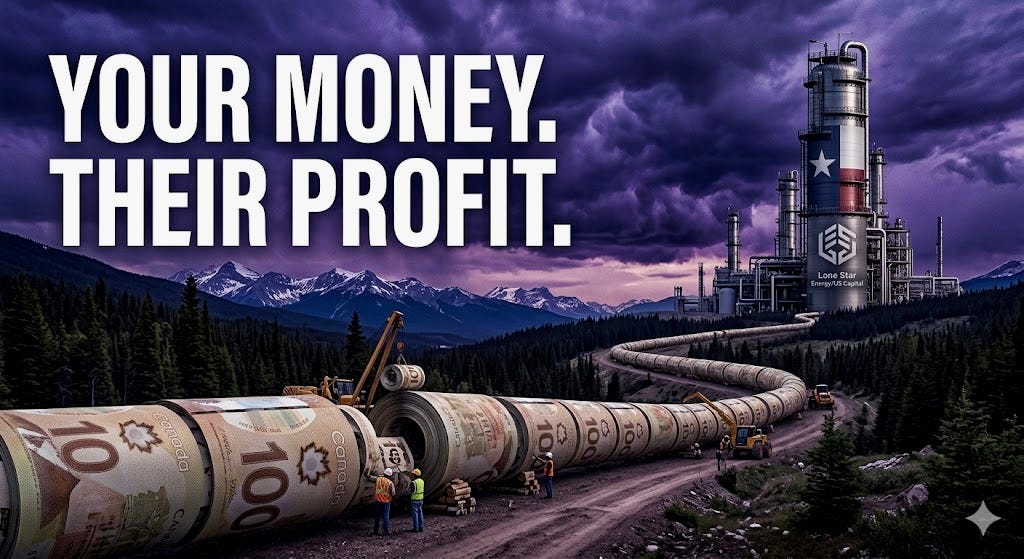
When it comes to the sprawling network of natural gas operations, fracking fields, and multi-billion-dollar pipeline corridors slicing through Western Canada, the “free market” has always been a complete myth. Instead, Canada has a long, institutionalized history of forcing its taxpayers to act as an uncredited, non-voting venture capital fund for some of the richest multinational corporations on earth—specifically U.S.-backed energy empires.
This is where the story hits the road. To get the specific quotes, the hard numbers, the details on David Eby’s visible public meltdown, and learn exactly how politicians in Ottawa, Victoria, and Edmonton sign away your taxpayer dollars to corporate giants while bleating the opposite to the cameras, you need to unlock the full investigation.
BEFORE YOU READ ON — SOMETHING YOU NEED TO KNOW BY WEDNESDAY.
Pulse — The Podcast launches this month. Two broadcasters. Two countries. Politics first. Nothing off limits.
George Froehlich and Tamara Stanners. Canadian and American politics. The stories both countries are missing about each other. Every paid subscriber gets it free. No extra cost. Ever.
The founding rate — CA$30 a year — ends Wednesday June 11. After that: CA$48.
A History of Bleating One Thing, While Backstopping Another
The federal government’s addiction to corporate welfare is an institutionalized double-standard. For years, federal leaders have stood at podiums preaching fiscal discipline, while privately absorbing massive financial risks for foreign conglomerates.
Look back at the defining moment of modern Canadian infrastructure: the original Kinder Morgan pipeline drama. When the Texas-based energy giant realized that the fierce political and legal resistance to twinning the Trans Mountain pipeline (TMX) was threatening its corporate bottom line, its executives didn’t double down on private enterprise. They weaponized their leverage, threatened to walk away entirely, and forced Ottawa to buy them out.
Today, the public capital cost for that single corporate safety net has ballooned to a staggering $34 billion.
But the real corporate welfare isn’t just the purchase price; it’s happening right now in the ongoing, brutal regulatory hearings before the Canadian Energy Regulator (CER). The pipeline’s construction costs blew past all estimates. A true free-market solution would dictate that the commercial oil companies using the pipeline must pay higher toll fees to cover those cost overruns.
Instead, massive oil shippers—including major international producers—are aggressively fighting the proposed tolls. And who is backing them up? Alberta Premier Danielle Smith, who has publicly demanded that the federal government keep those toll rates artificially low. By coddling the shippers, politicians are ensuring that the Canadian taxpayer, rather than multinational oil companies, will absorb billions in unrecovered debt overruns. The message from Ottawa and Edmonton is consistent: the private sector must stand on its own two feet—unless international corporations face market risks, in which case the public absorbs the blow.
The Carney-Smith Alliance and David Eby’s Raw Fury
The absolute peak of this political hypocrisy was laid bare with the shocking energy agreement signed between Prime Minister Mark Carney and Premier Danielle Smith. For years, Carney maintained an elite, globalist stance on environmental finance, famously warning the international community that fossil fuel investments that fail to prepare for a green transition run the risk of becoming economically unviable “stranded assets.”
Yet, facing a volatile trade landscape dominated by Donald Trump’s aggressive tariff threats, Carney completely abandoned his high-minded “stranded asset” rhetoric. In a blatant display of political expediency, Carney and Smith stood side-by-side to sign a sweeping memorandum of understanding that actively greenlights a brand-new bitumen pipeline corridor to the West Coast, targeting a construction start date of September 2027. To build “social license” for the project, the deal couples the pipeline with massive public subsidies for carbon-capture infrastructure—a multi-billion-dollar corporate handout.
The fallout from this backroom deal has triggered a political earthquake across the Rockies. Watching B.C. Premier David Eby on television responding to the Carney-Smith alliance, the public witnessed a politician completely unraveled. Eby—usually a master of calm, scripted talking points—was visibly shaking, red-faced, and utterly furious at the microphones.
Eby lost his temper, losing all diplomatic composure as he lashed out at Ottawa for completely bypassing British Columbia to appease Alberta’s sovereignty threats:
“This country cannot work if separatists, separatist premiers, others get all of the attention of the federal government. This is rewarding bad behaviour.”
— B.C. Premier David Eby
Eby’s raw, unfiltered anger wasn’t just about regional alienation; it was the sound of a politician realizing he had been completely outmaneuvered on the national stage. He blasted the federal government for prioritizing a multi-billion-dollar pipeline bailout for Alberta oil companies while completely failing to include B.C.’s struggling, tariff-battered softwood lumber industry in any federal relief packages.
The B.C. Double-Take: Eby’s Own $3-Billion Power Trip
However, Eby’s visible fury on television masks an equally glaring hypocrisy within his own borders. While he publicly rails against Ottawa for “rewarding bad behaviour” and bailing out Alberta oil companies, Eby has been quietly running his very own corporate welfare program in British Columbia.
On the campaign trail, Eby built his brand on standing up to big polluters, firmly stating that “we cannot continue to subsidize fossil fuels in the middle of a climate crisis.” But behind the scenes, when multinational consortia like LNG Canada demanded that their massive coastal facilities be hooked up to clean electricity to lower their carbon footprint, Eby opened the public vault.
Rather than forcing these incredibly profitable foreign-backed corporations to pay commercial retail rates to build out the grid, Eby directed B.C. Hydro to fund a massive, specialized $3-billion high-voltage transmission line into the province’s northwest. Local B.C. taxpayers are essentially footing the multi-billion-dollar capital bill to build electrical infrastructure primarily for foreign-owned extraction sites. Eby is forcing everyday citizens to subsidize the utility costs of global corporations so they can pad their margins and boast about “green” fracking.
Add to that the province’s deep-well royalty credit loops, which allow natural gas corporations to systematically slash their royalty payments to the public treasury:
The Royalty Drain: In a single fiscal year, these specialized programs enabled natural gas corporations to wipe out nearly $450 million in royalty obligations that should have gone toward B.C. healthcare, schools, and roads.
What the Public Actually Thinks: The Great Disconnect
Politicians run this shell game because they believe the public is blinded by partisan loyalty or regional pride. But when pollsters peel back the layers, they expose a massive disconnect between political actions and public desires.
Data from national polling consistently shows a fascinating paradox: while a majority of Canadians (58%) support or accept the general economic growth of the domestic oil and gas sector, they draw a hard, uncompromising line at public handouts.
When asked specifically about corporate welfare, two-thirds of Canadians (66%) explicitly object to oil and gas companies receiving public subsidies, with a staggering 41% stating they “strongly disagree” with the practice.
The public isn’t stupid. They understand that these multi-billion-dollar energy majors are currently printing historic, record-breaking profits. The average voter supports energy sector workers, but they are completely fatigued by watching corporate executives collect massive bonuses while their own public hospitals, schools, and electrical grids are squeezed for funding. The politicians think the public doesn’t know—but the numbers show the public is furious.
The Verdict: A Nation of Subsidized Landlords
This isn’t nation-building; it’s economic subservience. True economic sovereignty means that if the public takes the multi-billion-dollar risks, the public owns the equity.
Instead, our current political class—from Carney in Ottawa, to Eby in Victoria, to Smith in Edmonton—has trapped us in a system where Canada plays the role of a desperate landlord. They scream at each other on television for political theater, but behind the scenes, they are completely aligned: slashing corporate taxes, subsidizing the drilling, building the pipelines with public money, spending billions on hydro extensions, and keeping toll rates artificially low, all to ensure that foreign capital remains interested.
As Donald Trump aggressively weaponizes trade tariffs against Canadian exports and demands total economic dominance, Canadians are waking up to a terrifying reality: We are actively using our own public tax dollars to subsidize the infrastructure of American-linked companies that are draining our natural resources.
The public fatigue has reached a boiling point. The truth is out. Western Canada’s energy corridor isn’t a triumph of the free market—it’s a taxpayer-funded gravy train for foreign corporate elites, and it’s time to call it exactly what it is.
Did this investigative report cut through the noise? Canadian Pulse is growing by over 100 subscribers every single day because we print the hard data the corporate networks ignore. This is what independent journalism looks like.
We have a massive investigative pipeline ready to launch. Don’t leave your insights to chance—unlock our full archive of insider briefings and exclusive political analysis.
Have your say. Did you realize the sheer scale of the royalty breaks B.C. and Alberta were quietly handing to American consortia? How does this change your perspective on the politicians wrapping themselves in the flag?
We pride ourselves on our community discussion. Many of our best stories start as reader tips and questions, just like this one. Leave your perspective below.
Keep their elbows up. If you found this investigation powerful, think about who else in your network needs to see this data before the next election. Share this post with friends, family, or colleagues who are tired of the spin.
I have long suspected that the UCP had significantly reduced oil and gas royalties collected from corporations; I look forward to finding out the true costs of corporate welfare.
If we can't get the projects built without foreign investment and we can't get foreign investment without financial concessions, how do we get the projects built? Also, is there a way after the projects are up and running to increase Canada's share of the profits to offset the concessions? I admit these might be naive questions as I don't really understand the world of finance.