

SPECIAL REPORT - "We're Not Interested." Carney Just Said the Words Ottawa Has Avoided For a Year.
Carney is telling Trump exactly what Canada will and won't accept in a trade deal, and the timing suggests Canada is negotiating from strength.

NOTE FROM GEORGE
Earlier today, Canada showed its hand publicly, and it wasn't a hand of weakness. This is breaking news, and it matters. Here's what it tells us about who's actually driving this negotiation, and why the timing is no accident.
Something happened today that deserves more attention than it’s getting, because it hasn’t happened quite this way before.
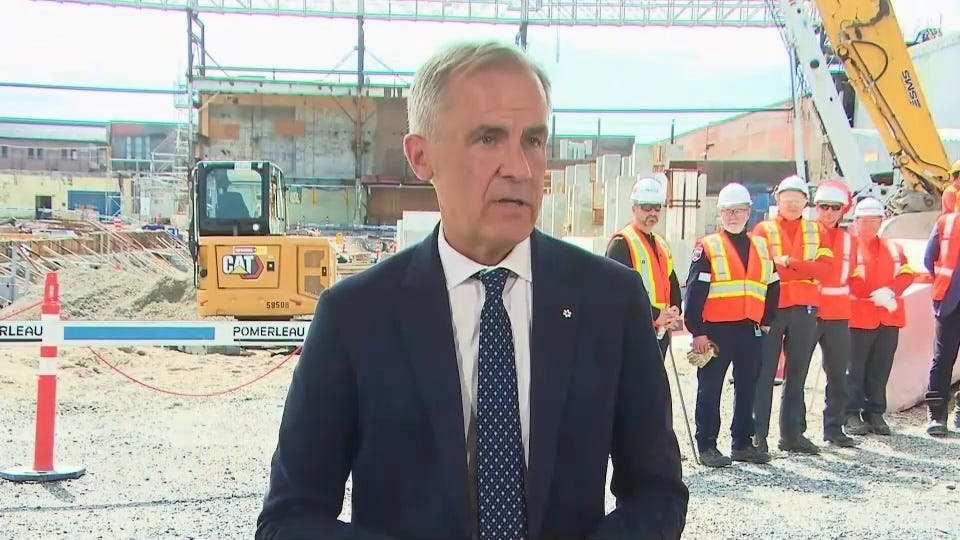
Speaking at an aluminum plant in Saguenay, Quebec, Prime Minister Carney ruled out a narrow, sector-by-sector trade deal with the United States entirely. “We’re not interested in a very targeted deal without connections to other sectors,” he said. “We’re interested in a more comprehensive deal, more global deal.” Any real agreement, he said, has to cover autos, steel, aluminum, and forest products together, not whichever pieces happen to be furthest along in talks.
That’s a harder, more public line than he’s ever drawn before, and he drew it today, not in some backgrounder or leaked memo, on camera, at a podium, in plain English. It wasn’t just aimed at Washington. It was aimed at us too. For the first time, Canada isn’t just reacting to what Trump throws at it, it’s telling both countries, out loud, exactly which road it intends to drive down to get a deal. Here’s the highway, here’s where it goes, and we’re staying on it.
Why now, and why this might mean Canada is actually in the driver’s seat
The timing raises a real question, one worth sitting with rather than rushing past: is this a sign Carney senses genuine weakness in Trump’s position, or is it something else entirely?
Likely, it’s a combination of factors, and all of them point the same direction.
First, it’s a message to Canadians as much as to Washington. Confidence in Carney’s ability to land a good deal dipped from 51 to 43 percent over the summer. Going public and firm reassures the country that the strategy hasn’t wavered, that we’re not scrambling for any deal just to end the discomfort, we’re holding out for the right one.
Second, Trump is not negotiating from a position of strength right now, and Carney may simply be reading that correctly. Tariffs are costing the average American household roughly $1,000 this year. Disapproval of his handling of trade sits above 60 percent. That pain is showing up in places voters actually notice, groceries, appliances, clothing. If there was ever a moment to hold firm rather than accept a partial deal, this looks like it.
Third, and this is the piece that ties it together: the midterms. Republicans are heading into November already nervous, with strategists privately warning both the House and Senate could be at risk if the economic mood doesn’t turn around before voters go to the polls. That’s exactly the kind of pressure that makes a fast, partial win attractive to Washington, a narrow deal on steel and aluminum, announced with fanfare before the fall, regardless of whether it actually resolves anything for autos or forest products.
Which raises the real question worth asking. If a narrow, sector-only deal is genuinely what’s on the table, why would that benefit an administration heading into a tough midterm more than a comprehensive one would? The honest answer is probably that it doesn’t benefit Trump’s actual economic position, it benefits his messaging. A narrow deal lets the White House claim a “win” on the news cycle before November without doing the harder work of resolving autos, the sector that would require real concessions. Carney publicly refusing to accept exactly that kind of headline-only deal isn’t only about protecting Ontario’s auto sector. It denies Washington the easy political photo-op it may be counting on, and forces the hardest sectors onto the table before any deal gets announced at all.
If that reading is right, Canada isn’t just holding a defensive line here. It’s setting the terms.
The pattern was already there, if you were watching
This isn’t the first sign of it. Look back just days ago, and the same posture shows up again.
Trump called Canada “nasty” five times in one speech, from a stage in Las Vegas. “I love the people, but they’re nasty. Nasty leadership,” he repeated, over and over. That’s not a slip, it’s a tactic. When Trump wants to provoke a reaction, he throws out a firebrand bon mot and waits to see who takes the bait, a loaded word repeated enough times to guarantee headlines, designed to bait an emotional response he can then point to as proof.
Carney didn’t take it. Two sentences, total. “We can change the adjective and say ‘nasty,’ if you will,” he said, and moved straight on to talk about the next phone call. No press conference. No outrage. He simply declined to play the part Trump had written for him.
Put the two moments side by side and the pattern is unmistakable. Refuse the bait on the small provocation. Draw the hard line on the real substance. That’s not a prime minister improvising. That’s a strategy, executed twice in one week.
Fair enough, nobody enjoys living inside a trade war, and it’s reasonable to want it resolved. But before that restlessness talks anyone into giving away leverage we’ve already built, it’s worth asking what exactly we’ve accomplished so far, and how much we still have left to use.
Here’s what’s waiting behind it:
The Republican lieutenant governor who came home from Canada stunned by what he heard
The four US senators who flew to Ottawa this summer to try to fix this personally
Why even Las Vegas is begging, and what it’s offering to get Canadians back
