
When Children Become Targets: The Moral Outrage We Can No Longer Contain

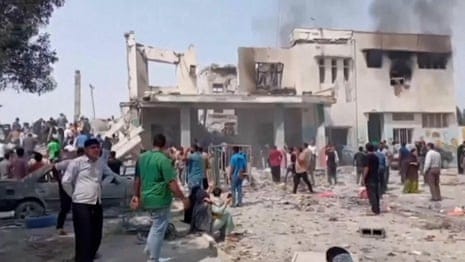
In an age of precision warfare, why can’t a missile avoid a school?
The moral outrage is impossible to contain. Children are being killed in places that should be the safest corners of their world—classrooms, playgrounds, schoolyards. The strike on the girls’ school in Minab, Iran, is another unbearable example: 148 lives lost, 95 wounded. These were children who woke up expecting a school day, not a final one. No society, no conflict, no justification can make sense of that.
The grief is universal. The shock is universal. And the question that rises—again—is universal: How is this still happening?
The contradiction at the heart of modern warfare
What makes this tragedy even harder to accept is the world we live in—a world where modern military technology can target a single room inside a fortified compound with astonishing precision. Satellites, heat‑signature tracking, real‑time imaging, and guided systems are all designed to reduce civilian casualties.
And yet a school was hit.
When technology can distinguish between structures, track moving vehicles, and identify individuals, the continued deaths of children in classrooms strain credibility. The gap between what is claimed and what is happening on the ground is no longer a technical question—it is a moral one.
If precision is possible, then protection should be possible.
If accuracy is achievable, then avoiding schools should be achievable.
If we can strike with intent, then we can avoid striking children.
The contradiction is stark, and it demands scrutiny.
A global pattern that refuses to break
The tragedy in Minab echoes what the world has seen in Gaza and other conflict zones: children disproportionately harmed, schools struck, families shattered. Different conflicts, different actors—but the same devastating outcome.
Across continents and conflicts, the pattern repeats:
Schools become targets.
Shelters become unsafe.
Children become casualties of decisions made far from their lives.
This is not a regional issue. It is not a political issue.
It is a human issue.
And it is a pattern the world has failed to break.
The human cost behind the numbers
Numbers alone cannot carry the weight of what happened in Minab. Behind each number is:
a family that will never be whole again
a community that will never forget the sound of that morning
a future that ended before it began
These are not abstractions. These are children who should have been learning, laughing, and growing—not becoming statistics in a conflict they had no part in creating.
The responsibility that comes with modern power
Modern warfare comes with extraordinary capabilities. With those capabilities comes responsibility—ethical, legal, and human. When technology can deliver precision, the world has every right to expect that precision to be used to protect civilians, especially children.
When that does not happen, the question is not about machinery.
It is about choices.
Closer
There comes a point when moral outrage is not only justified but necessary. Minab has brought us to that point again. The world cannot keep rewriting the same story, where children pay the highest price for conflicts they never chose. Precision without protection is not progress—it is a betrayal of our shared humanity.
Those nations that purport to minimize “collateral damage” of civilians by nations engaging in war (whether unjustified or not) continue to do so be it in Iran or Gaza.
The US after losing 18 American personnel in Mogadishu Somalia in 1993 influenced Americans not to provide any peacekeeping forces for the Rwandan genocide under UN command of Canadian General Romeo Dallaire. Dallaire, in his excellent book on the genocide, stated that Americans would not tolerate the loss of one service member for 800,000 thousand or so people killed in a country in conflict.
So I’m not sure collateral damage of school children killed in Iran would concern them greatly.