


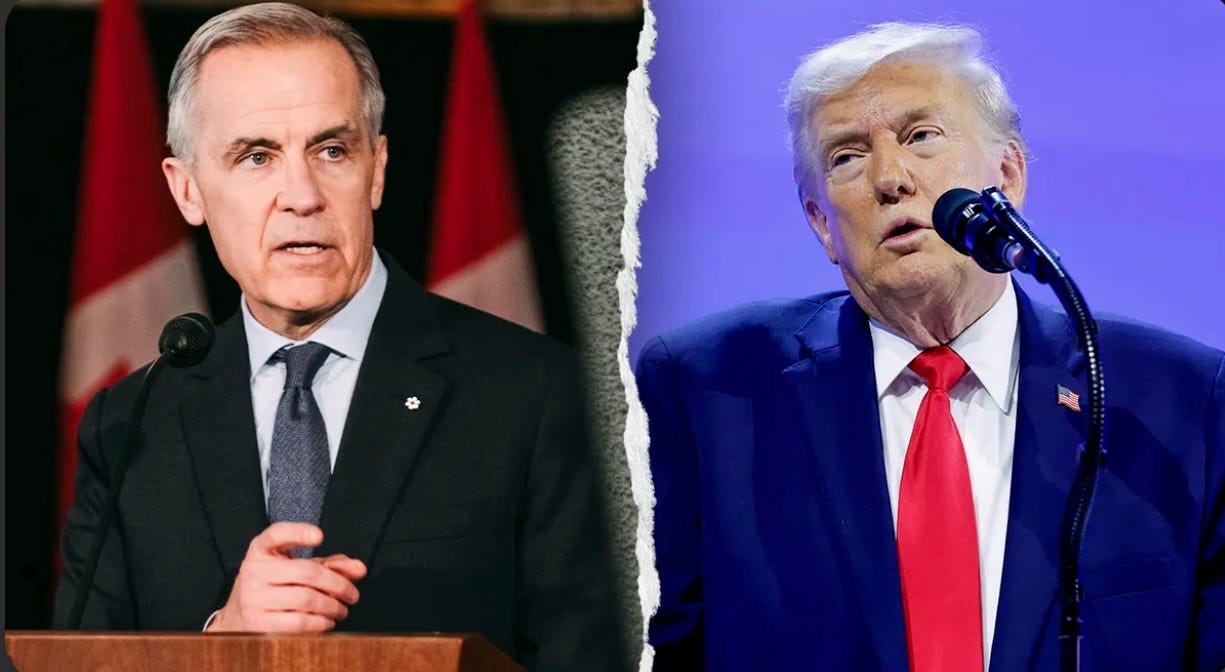
Two days before U.S. President Donald Trump’s tariff deadline hits, Monday delivered two developments that only make sense together.
In St. John’s, Prime Minister Mark Carney stood alongside Newfoundland and Labrador Premier Tony Wakeham and Quebec Premier Christine Fréchette to announce a new Churchill Falls energy agreement - replacing the 1969 contract that saw Quebec buy Labrador hydro power at rock-bottom prices for more than half a century. Ottawa is calling it the largest clean energy investment in North American history, valued at nearly $70 billion. The package includes $10 billion in federal financing to expand the Churchill Falls generating station, build the long-discussed Gull Island hydroelectric project, construct new transmission lines, and add a 2,000 megawatt onshore wind project in Labrador. Together, the projects will nearly triple Churchill Falls’ current output - enough new power to light, heat, and cool every home in Toronto, Montreal, and Vancouver combined - and are expected to support 23,000 jobs.
Buried in the technical details is the line that matters most for Washington: the deal locks in guaranteed transmission access of 985 megawatts through Quebec, letting Newfoundland and Labrador sell Churchill River power into markets beyond Canada’s borders. Massachusetts has already been floated as one potential buyer. That’s not incidental. Hydro-Québec is facing a tightening domestic supply picture of its own, and demand tied to artificial intelligence and data centre growth is straining electricity grids on both sides of the border. Churchill Falls now represents new export capacity aimed squarely at that U.S. shortfall.
Carney made his intentions explicit: when he speaks with Trump, Churchill Falls comes up first, before trade. It’s a deliberate sequencing. Lead with what Canada can offer - a massive, reliable new power source at a moment U.S. demand is outpacing supply - before getting into what Canada wants relief from.
That trade conversation is already underway, and Monday’s session in Washington carried more weight than the rounds that came before it. Commerce Secretary Howard Lutnick joined U.S. Trade Representative Jamieson Greer at the table with Canada’s Dominic LeBlanc and chief negotiator Janice Charette - the first time he’s sat in on this stage of the talks. The distinction matters: Greer’s office has led the broader negotiations for weeks, but it’s Lutnick’s department that holds formal, direct authority over the Section 232 tariffs on steel, aluminum, autos, and forest products - the two areas identified as the real sticking points in the “phase one” deal under discussion. Greer can negotiate around those issues; he can’t unilaterally move them. Lutnick can.
His arrival now, two days before the deadline and at the session expected to produce the “options” going to Carney and Trump, is not a routine check-in. It suggests Washington may be preparing to actually move on autos and metals rather than run out the clock to Aug. 19 - and it raises the stakes if talks stall anyway, since the person with sign-off authority was in the room.
The expected next step: today’s session concludes, options go to both Carney and Trump, and the two leaders speak directly. Carney has said repeatedly he won’t accept a “bad deal.” Whether Churchill Falls softens the ground before that call remains to be seen. Two days to the deadline.
This is a developing story. We’re tracking both threads closely and will post updates as they warrant.
Thanks again, George, for bringing us the news that counts. Politics has become a game of poker, and in this vein, Carney vs. Trump would normally be a foregone conclusion. Not only does Carney hold a few aces up his sleeve, as this article and your previous ones have outlined, but the evil King has no concept of a straight face or any real comprehension of how to use fact versus fiction in a negotiation.
But…we're talking about making a deal with a man who makes and unmakes deals with little regard for formal signatures. That's the part poker can't model. In poker, once the hand's played, the chips move and stay moved. With this administration, the chips move, get photographed moving, and then quietly move back the moment it's convenient, with a straight face and no acknowledgement anything happened at all.
Which is exactly why leading with Churchill Falls instead of trade is the smarter play than it first looks. A tariff concession is a promise about tomorrow, and tomorrow is precisely where this man's word has never once held. A 985-megawatt export line into a US grid already straining under AI demand is a fact today, humming, delivering power whether or not Trump feels like honouring anything he said last Tuesday. Carney isn't just showing Trump a card. He's showing him something the King can't later pretend was never dealt, because Massachusetts will be able to feel the difference in its own electricity bill. That's not a hand played against Trump's bluffing. It's a hand played against his memory, and this King is well known for having none that inconveniences him.
Second point: Electricity to trade will be attractive to the Americans and at least is a positive lever.
It also will remind Trump of Ford’s threat to surcharge energy to northern tier states. I bet Trump doesn’t think we would do anything really “nasty” for fear of his revenge. Because of his sense that he’s fearsome, we can use that to our advantage. I’m sure PM Carney has already thought about what retaliation would be most effective and how it can be surgically applied.
We won’t/can’t hold back on Red River and Columbia River flows in a year of drought, or stop helping with wildfires, but everything Canadian needs to be surcharged, export taxed or otherwise made painful enough so that the US feels at least the same pain as Canada. And Canadians of all partisan stripes need to support the Carney government as we navigate these rapids rather than complain.